

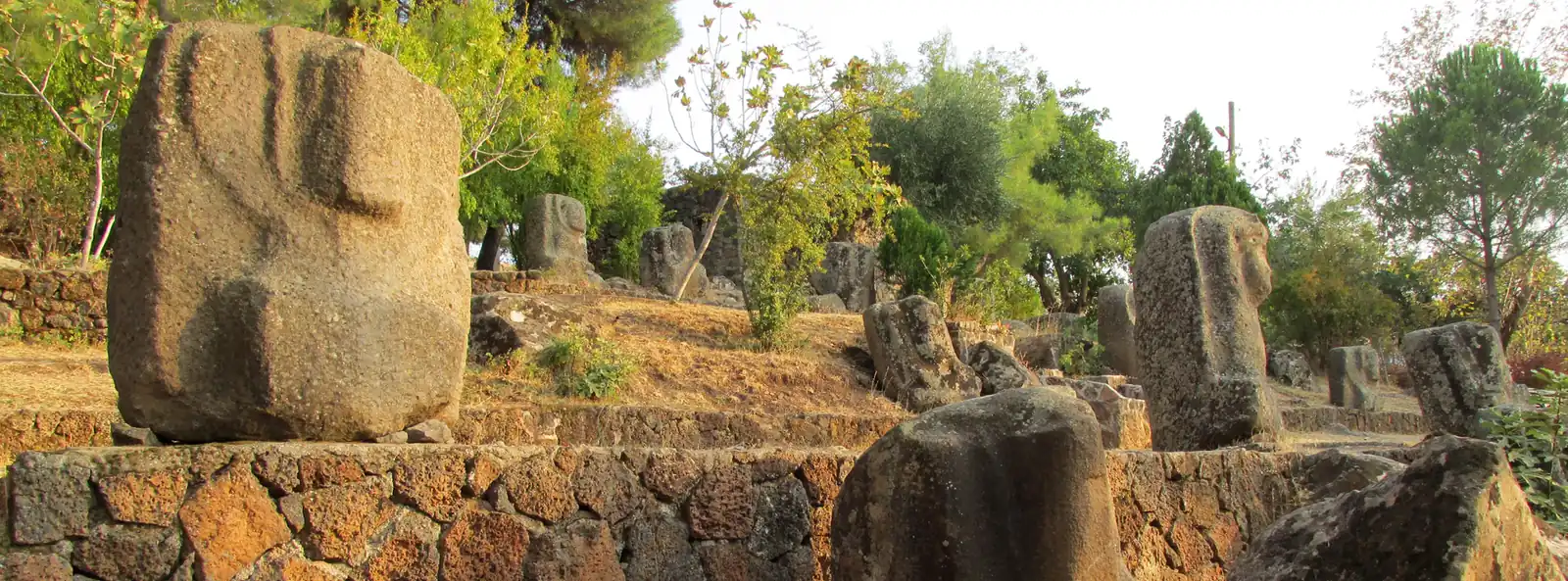


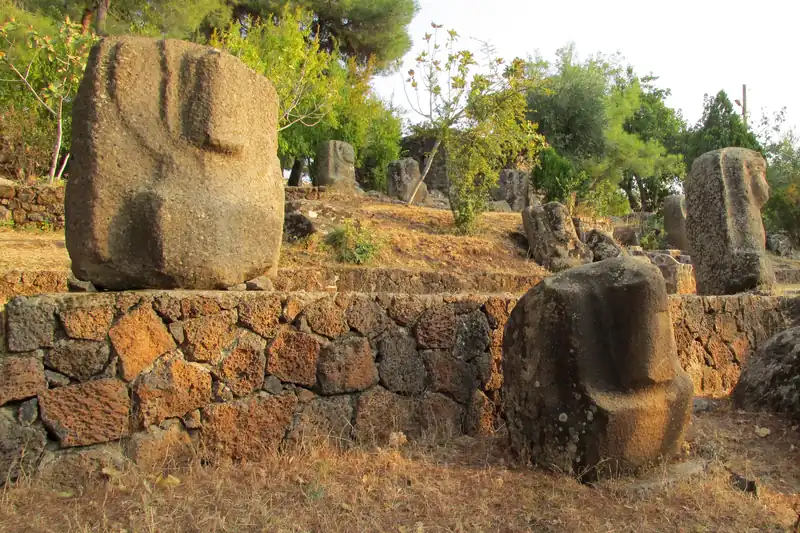
Hundreds of basalt sculptures scattered across a hillside on the eastern slopes of the Nur Mountains: lions only half carved, sphinxes whose faces have just begun to emerge, blocks cut from the quarry that never reached their destination. Yesemek Open-Air Museum shows a sculpture workshop exactly as it was abandoned more than three thousand years ago. Lying about an hour and a half from Osmaniye, it makes a good day trip. Below you will find where it is, its story, the route and notes for a winter visit.
Where is Yesemek Open-Air Museum?
The museum is in the İslahiye district of Gaziantep, on the Karatepe ridge of Yesemek village. The Turkish Museums site of the Ministry of Culture and Tourism places it 22 km southeast of İslahiye; the short address is "Yesemek Köyü, İslahiye/Gaziantep". The site was landscaped by the Gaziantep Museum Directorate and turned into an open-air museum.
On the map you drive as far as İslahiye and then turn off onto village roads. We cover the journey to the district itself in our guide on taxis from Osmaniye to İslahiye; this guide focuses on the museum beyond the town.
The story of a Hittite sculpture workshop
According to the Turkish Museums description, Yesemek was the largest quarry and sculpture workshop in the Near East from the last quarter of the 2nd millennium BC until the 8th century BC. It began working when the region came under Hittite rule, in the reign of King Šuppiluliuma I (1375–1335 BC), and local Hurrian craftsmen worked here. Production slowed for a while, then picked up again in the period of the Late Hittite kingdoms.
In the last quarter of the 8th century BC the Assyrians closed the workshop and took the masters to Assyria. Everything left behind stayed as it was, and the site remained almost forgotten until 1890. Most of the more than 300 sculpture sketches on display today are gate lions; alongside them are sphinxes, seated and winged lions, reliefs of a mountain god representing the Amanos Mountains, and battle-scene reliefs. Because every stage, from cutting the stone out of the quarry to shaping the sketch, can be seen in one place, Yesemek feels like an open-air school.
The road from Osmaniye to Yesemek
Distance and time to the museum site, measured with OSRM on the OpenStreetMap road network:
| From – to | Road distance | Traffic-free time |
|---|---|---|
| Osmaniye centre – Yesemek | ~100 km | ~1 h 30 min |
| Fakıuşağı (our rank) – Yesemek | ~106 km | ~1 h 35 min |
- Osmaniye – Nur Mountains: head east on the O-52 motorway and cross the mountains through the Kızlaç Tunnel.
- Nurdağı – İslahiye: leave the motorway near Nurdağı and take the D825 south towards İslahiye.
- İslahiye – Yesemek: without entering the town centre, turn onto the village roads to the east and reach Yesemek via Karapolat.
There is a toll on the motorway; the General Directorate of Highways publishes the current rates on kgm.gov.tr. The last kilometres are on a narrow village road, so slow down.
Opening hours and winter notes
- Hours: the Turkish Museums page lists 08:00–17:00 for the winter period (1 October–1 April), with the ticket office closing at 17:00. Entry appears there as free; check the current situation on turkishmuseums.com before you go.
- Walking: the sculptures are spread over a terraced slope, and the paths are steep and stony in places. Wear shoes with good grip that support your ankles.
- Weather: mornings in November are cool and it gets dark early in the afternoon. You will spend time on a shaded slope, so bring a warm layer.
- Time: allow at least an hour to walk around without hurrying; for photographs, the low afternoon light brings out the texture of the basalt.
A day trip by taxi
Yesemek is outside our province, so the taximeter does not apply on this trip; we agree the price together before setting off. It depends on your pick-up address, the number of passengers, how long you stay at the museum and whether you want to stop somewhere else on the way back. If you would like to continue to Gaziantep on the same day and see the Zeugma Mosaic Museum, we can plan the route with you. For trips with a long wait, an hourly taxi can be the more comfortable option.
Ask for a fixed-price quote
On long trips we give you a fixed price before departure instead of running the meter. Fill in the form; it opens in WhatsApp with the template below and we reply with the price in the same chat.
Template: “From · To · Date · Time · Passengers · Luggage · One way / Return”. We agree details such as motorway, waiting and the return trip together in the quote.
Tip: The Turkish Museums page lists only toilets as a facility on site; bring water and a snack with you before you set off.
Frequently asked questions
It is in the İslahiye district of Gaziantep province, on the Karatepe ridge of Yesemek village. According to the Turkish Museums site of the Ministry of Culture and Tourism, it lies 22 km southeast of İslahiye.
Measured on the OpenStreetMap road network with OSRM, the drive from Osmaniye city centre to the museum is about 100 km, roughly 1 hour 30 minutes without traffic. From our rank in Fakıuşağı it is about 106 km.
More than 300 sculpture sketches are on display, most of them gate lions. There are also sphinxes, seated and winged lions, reliefs of a mountain god representing the Amanos Mountains, battle-scene reliefs and architectural pieces.
The Turkish Museums page lists 08:00–17:00 for the winter period (1 October–1 April), with the ticket office closing at 17:00. Hours can change, so check the same page before you go.
